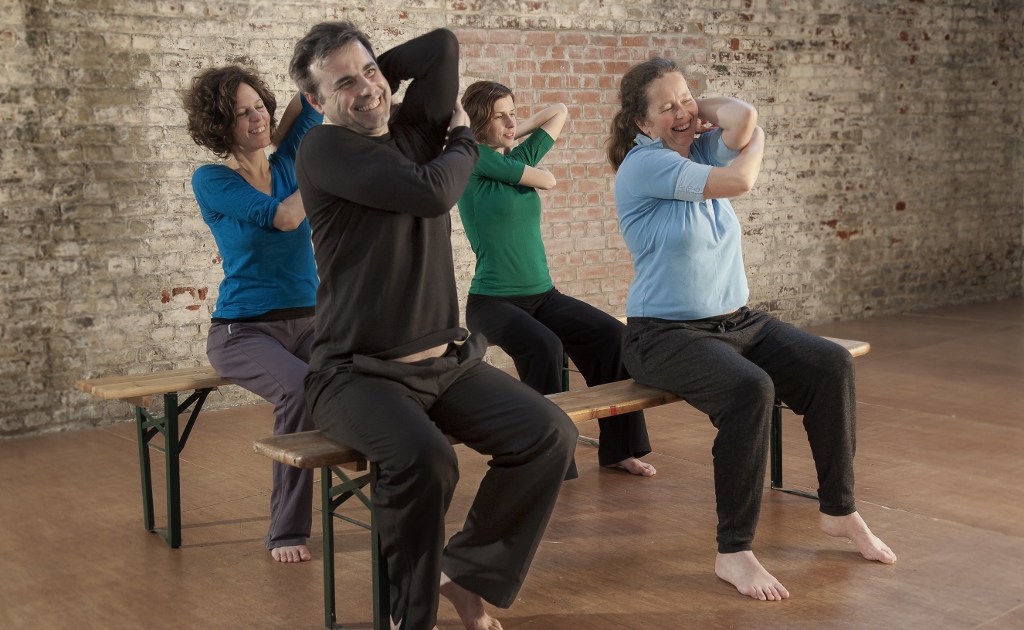
Shelagh O’Neill is leading a four-year Feldenkrais training for practitioners in Bath, starting May 2026. She was one of the teachers on my training in London, which began in 2011. In case you might be interested in signing up, I’m going to share some reflections on my course.
Like many, I was not at all clear that I would actually become a practitioner, but knew I had a strong connection with the work and wanted to try it out.
Somehow it fitted me very well – even with my weird and wonderful way of dealing with the world. It was not an imposition, it was not a struggle. Once I was in the room, it happened with ease, joyfully and I could be myself and thrive (though of course, over the course of 4 years, there are a few setbacks!)
After I left school, I realised that in fact I did love learning – and took many courses, and changed direction several times professionally. But somehow it never quite worked.
Feldenkrais though was different. I remember Elizabeth Beringer – our Educational Director – saying that for the first year or so, you can just swim in the ‘Kinaesthetic Soup’. There seemed no necessity to take notes, revise material or work out what was going on at an intellectual level. It was simply enough to be and to experience. I found that very liberating. I had always struggled with synthesising things in my head, and it felt like a release. Of course, understanding the context of the work is really important, but comes later in the training (and continues long after.)
I had no experience working professionally with my hands. I remember clearly our first hands-on practice of touching our partners chest or tummy, and noticing the movement of breathing. It seemed so simple, yet was so profound, and really brought home to me the power of gentle, aware touch. I tried something similar on an insomniac friend that evening, and she almost immediately fell asleep. The clarity and power of the practice seemed palpable.
The course was almost entirely experiential (I think we had to submit one shortish piece of written work over the 4 years). It was clear that getting to grips with the reading list could enhance the experience, but it was wonderful for me to know that it wasn’t essential to do lots and lots of reading. With two very young children, one born during the first year of the training, it just wasn’t realistic for me. So there were no written exams, or need to remember things to then regurgitate them.
Obviously it’s a big commitment, 40 days or 8 weeks / year. In my own mind, I could only think about the next segment coming up, usually 2 or 3 weeks long. How on earth could I find the time off work and make sure we had childcare? But somehow it fell into place, segment after segment. Inevitably, there was occasionally a sense of wanting to complete the training – so that we could get on and practice. Yet once it had finished there was a big hole in my life. The structure had been very helpful (always a bonus for a freelancer), and I realised it had been like going on a retreat 3 or 4 times a year to recharge my system.
The material was very rich, the teachers excellent and my co-students great. I’m still in touch with many of them today. Time and again the learning and work showed that change can happen, that tuning in to our awareness is such a powerful tool, and you don’t have to be forceful or induce pain or discomfort to make a shift. It’s just like a Feldenkrais class writ-large in that way.
Being in a big group amplifies the effect. A second clear memory: during our assessment sessions close to the end I looked across the room at 30 or so people practising. The calm, purposeful atmosphere was surprisingly moving. The sense of possibility and tangible optimism was a wonderful thing to behold. A manager of one of the venues who we’d seen from the beginning had a session with a colleague, got up and suddenly looked 15 years younger, with shoulders back and head upright. The sense of possibility such a sight gives is very powerful.
The assessment is rigorous and integrated into the learning experience, through observed sessions with members of the public. My hands-on work came together towards the end, in spite of my doubts until late on. It’s so nice to know that you can really trust the process, and the teachers.
The remarkable thing was that at the end of it I had a set of skills and a certificate (whereby outside structures somehow, finally, coincided with my own sense of their worth) which gave me an opportunity to earn a living, and pursue my life’s work. The world outside the training room is not always open to the ways of thinking and action that Feldenkrais develops. In a sense, that’s why it’s so powerful – it’s counter-cultural and works because it’s different. Earning a living requires dedication, passion and belief. The training is an amazing way to stock up on all those qualities to bring them to bear on the world.